
#1844 VMFA-224, F-35B Lighting II print
Description
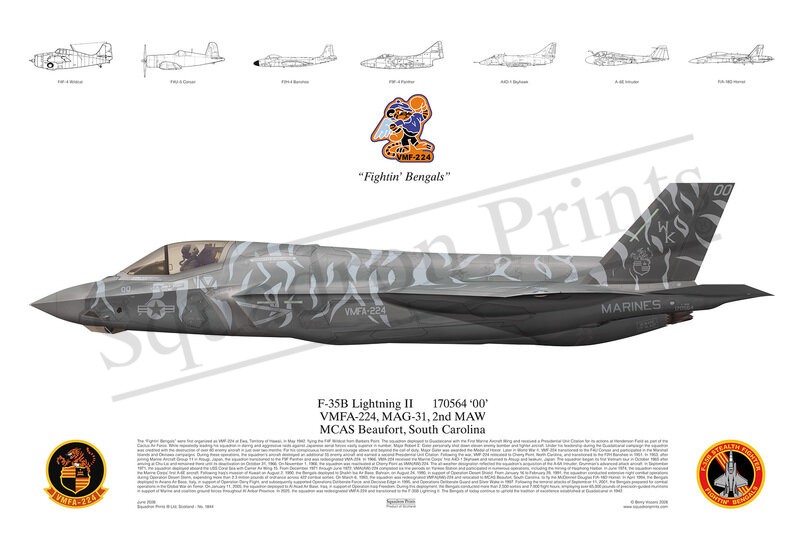
Squadron Prints Lithograph No. 1844 - 170564 '00', F-35B Lighting II, VMFA-224, MAG-31, MCAS Beaufort, SC.
The “Fightin’ Bengals” were first organized as VMF-224 at Ewa, Territory of Hawaii, in May 1942, flying the F4F Wildcat from Barbers Point. The squadron deployed to Guadalcanal with the First Marine Aircraft Wing and received a Presidential Unit Citation for its actions at Henderson Field as part of the Cactus Air Force. While repeatedly leading his squadron in daring and aggressive raids against Japanese aerial forces vastly superior in number, Major Robert E. Galer personally shot down eleven enemy bomber and fighter aircraft. Under his leadership during the Guadalcanal campaign the squadron was credited with the destruction of over 60 enemy aircraft in just over two months. For his conspicuous heroism and courage above and beyond the call of duty, Major Galer was awarded the Medal of Honor. Later in World War II, VMF-224 transitioned to the F4U Corsair and participated in the Marshall Islands and Okinawa campaigns. During these operations, the squadron’s aircraft destroyed an additional 55 enemy aircraft and earned a second Presidential Unit Citation. Following the war, VMF-224 relocated to Cherry Point, North Carolina, and transitioned to the F2H Banshee in 1951. In 1953, after joining Marine Aircraft Group 11 in Atsugi, Japan, the squadron transitioned to the F9F Panther and was redesignated VMA-224. In 1966, VMA-224 received the Marine Corps’ first A4D-1 Skyhawk and returned to Atsugi and Iwakuni, Japan. The squadron began its first Vietnam tour in October 1965 after arriving at Chu Lai and remained there until its deactivation on October 31, 1966. On November 1, 1966, the squadron was reactivated at Cherry Point as VMA(AW)-224. The all-weather designation reflected the squadron’s acquisition of the A-6A Intruder, Grumman’s advanced attack aircraft. In September 1971, the squadron deployed aboard the USS Coral Sea with Carrier Air Wing 15. From December 1971 through June 1972, VMA(AW)-224 completed six line periods on Yankee Station and participated in numerous operations, including the mining of Haiphong Harbor. In June 1974, the squadron received the Marine Corps’ first A-6E aircraft. Following Iraq’s invasion of Kuwait on August 2, 1990, the Bengals deployed to Shaikh Isa Air Base, Bahrain, on August 24, 1990, in support of Operation Desert Shield. From January 16 to February 28, 1991, the squadron conducted extensive night combat operations during Operation Desert Storm, expending more than 2.3 million pounds of ordnance across 422 combat sorties. On March 6, 1993, the squadron was redesignated VMFA(AW)-224 and relocated to MCAS Beaufort, South Carolina, to fly the McDonnell Douglas F/A-18D Hornet. In April 1994, the Bengals deployed to Aviano Air Base, Italy, in support of Operation Deny Flight, and subsequently supported Operations Deliberate Force and Decisive Edge in 1995, and Operations Deliberate Guard and Silver Wake in 1997. Following the terrorist attacks of September 11, 2001, the Bengals prepared for combat operations in the Global War on Terror. On January 11, 2005, the squadron deployed to Al Asad Air Base, Iraq, in support of Operation Iraqi Freedom. During this deployment, the Bengals conducted more than 2,500 sorties and 7,000 flight hours, employing over 65,000 pounds of precision-guided munitions in support of Marine and coalition ground forces throughout Al Anbar Province. In 2025, the squadron was redesignated VMFA-224 and transitioned to the F-35B Lightning II. The Bengals of today continue to uphold the tradition of excellence established at Guadalcanal in 1942.
You may also like
-
Tornado F3 First Flight PVC Patch
11 Sqn; 5 Sqn; 41 Sqn; 56 Sqn; 29 Sqn; 43 Sqn; 23 Sqn; 65 Sqn; 25 Sqn; 1435 Flt; 111 SqnRAF Leuchars; RAF Mount Pleasant, Falkland Islands; RAF Leeming; RAF Coningsby