
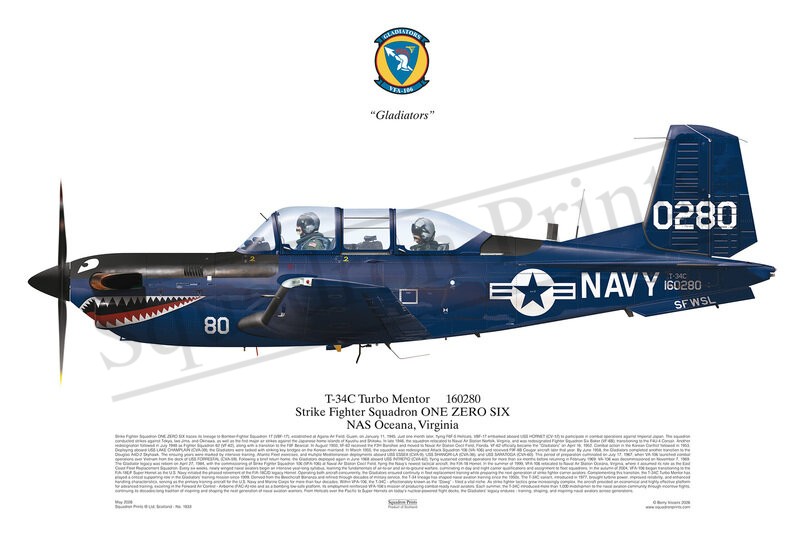
#1833 VFA-106, T-34C Turbo Mentor print
Description
Squadron Prints Lithograph No. 1833 - 160280, T-34C Turbo Mentir, Strike FIghter Squadron ONE ZERO SIX (VFA-106), NAS Oceana, Virginia.
Strike Fighter Squadron ONE ZERO SIX traces its lineage to Bomber-Fighter Squadron 17 (VBF-17), established at Agana Air Field, Guam, on January 11, 1945. Just one month later, flying F6F-5 Hellcats, VBF-17 embarked aboard USS HORNET (CV-12) to participate in combat operations against Imperial Japan. The squadron conducted strikes against Tokyo, Iwo Jima, and Okinawa, as well as the first major air strikes against the Japanese home islands of Kyushu and Shikoku. In late 1946, the squadron relocated to Naval Air Station Norfolk, Virginia, and was redesignated Fighter Squadron Six Baker (VF-6B), transitioning to the F4U-4 Corsair. Another redesignation followed in July 1948 as Fighter Squadron 62 (VF-62), along with a transition to the F8F Bearcat. In August 1950, VF-62 received the F2H Banshee and moved to Naval Air Station Cecil Field, Florida. VF-62 officially became the “Gladiators” on April 16, 1952. Combat action in the Korean Conflict followed in 1953. Deploying aboard USS LAKE CHAMPLAIN (CVA-39), the Gladiators were tasked with striking key bridges on the Korean mainland. In March 1955, the squadron was redesignated Attack Squadron 106 (VA-106) and received F9F-8B Cougar aircraft later that year. By June 1958, the Gladiators completed another transition to the Douglas A4D-2 Skyhawk. The ensuing years were marked by intensive training, Atlantic Fleet exercises, and multiple Mediterranean deployments aboard USS ESSEX (CVA-9), USS SHANGRI-LA (CVA-38), and USS SARATOGA (CVA-60). This period of preparation culminated on July 17, 1967, when VA-106 launched combat operations over Vietnam from the deck of USS FORRESTAL (CVA-59). Following a brief return home, the Gladiators deployed again in June 1968 aboard USS INTREPID (CVA-62), flying sustained combat operations for more than six months before returning in February 1969. VA-106 was decommissioned on November 7, 1969. The Gladiator legacy was reborn on April 27, 1984, with the commissioning of Strike Fighter Squadron 106 (VFA-106) at Naval Air Station Cecil Field, flying the Navy’s newest tactical aircraft, the F/A-18 Hornet. In the summer of 1999, VFA-106 relocated to Naval Air Station Oceana, Virginia, where it assumed its role as the East Coast Fleet Replacement Squadron. Every six weeks, newly winged naval aviators begin an intensive year-long syllabus, learning the fundamentals of air-to-air and air-to-ground warfare, culminating in day and night carrier qualifications and assignment to fleet squadrons. In the autumn of 2004, VFA-106 began transitioning to the F/A-18E/F Super Hornet as the U.S. Navy initiated the phased retirement of the F/A-18C/D legacy Hornet. Operating both aircraft concurrently, the Gladiators ensured continuity in fleet replacement training while preparing the next generation of strike fighter carrier aviators. Complementing this transition, the T-34C Turbo Mentor has played a critical supporting role in the Gladiators’ training mission since 1999. Derived from the Beechcraft Bonanza and refined through decades of military service, the T-34 lineage has shaped naval aviation training since the 1950s. The T-34C variant, introduced in 1977, brought turbine power, improved reliability, and enhanced handling characteristics, serving as the primary training aircraft for the U.S. Navy and Marine Corps for more than four decades. Within VFA-106, the T-34C - affectionately known as the “Dawg” - filled a vital niche. As strike fighter tactics grew increasingly complex, the aircraft provided an economical and highly effective platform for advanced training, excelling in the Forward Air Control - Airborne (FAC-A) role and as a bombing low-safe platform. Its employment reinforced VFA-106’s mission of producing combat-ready naval aviators. Each summer, the T-34C introduced more than 1,000 midshipmen to the naval aviation community through incentive flights, continuing its decades-long tradition of inspiring and shaping the next generation of naval aviation warriors. From Hellcats over the Pacific to Super Hornets on today’s nuclear-powered flight decks, the Gladiators’ legacy endures - training, shaping, and inspiring naval aviators across generations.
You may also like
-
Lancaster B.I
PA474 'KC-A'; KB726 'VR-A'; FM213; C-GVRA617 Sqn; 419 Sqn; BBMFRAF Coningsby -
14 different aircraft types
variousRAF Brize Norton; RAF Coltishall; RAF Kinloss; RAF Leuchars; RAF Marham; RAF Scampton; Heathrow; RAF Northolt; Warton -
Signed F-16 Fighting Falcon Nellis 'Crash'
85-1412 '512 TFS'512 TFS, 86 TFWNellis AFB, Nevada; Ramstein AB, Germany -
B-17F Flying Fortress
41-24485 'DF-A'324 BS, 91 BG(H), 8 AFRAF Bassingbourn, AAF Station 121