
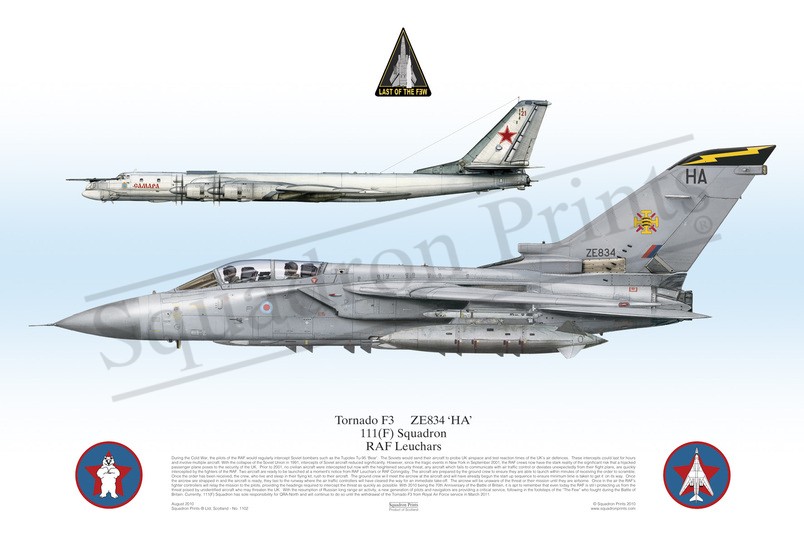
#1102 Tornado F3 and Tu-95MS
Description
Squadron Prints Lithograph No. 1102 - Tornado F3, ZE834 'HA', Tu-95 Bear '21' red, 111(F) Squadron, RAF Leuchars, Northern Quick Reaction Alert (QRA). During the Cold War, the pilots of the RAF would regularly intercept Soviet bombers such as the Tupolev Tu-95 ‘Bear’. The Soviets would send their aircraft to probe UK airspace and test reaction times of the UK’s air defences. These intercepts could last for hours and involve multiple aircraft. With the collapse of the Soviet Union in 1991, intercepts of Soviet aircraft reduced significantly. However, since the tragic events in New York in September 2001, the RAF crews now have the stark reality of the significant risk that a hijacked passenger plane poses to the security of the UK. Prior to 2001, no civilian aircraft were intercepted but now with the heightened security threat, any aircraft which fails to communicate with air traffic control or deviates unexpectedly from their flight plans, are quickly intercepted by the fighters of the RAF. Two aircraft are ready to be launched at a moment’s notice from RAF Leuchars or RAF Coningsby. The aircraft are prepared by the ground crew to ensure they are able to launch within minutes of receiving the order to scramble. Once the order has been received, the crew, who live and sleep in their flying kit, rush to their aircraft. The ground crew will meet the aircrew at the aircraft and will have already begun the start up sequence to ensure minimum time is taken to get it on its way. Once the aircrew are strapped in and the aircraft is ready, they taxi to the runway where the air traffic controllers will have cleared the way for an immediate take-off. The aircrew will be unaware of the threat or their mission until they are airborne. Once in the air the RAF’s fighter controllers will relay the mission to the pilots, providing the headings required to intercept the threat as quickly as possible. With 2010 being the 70th Anniversary of the Battle of Britain, it is apt to remember that even today the RAF is still protecting us from the threat posed by unidentified aircraft who may threaten the UK. With the resumption of Russian long range air activity, a new generation of pilots and navigators are providing a critical service, following in the footsteps of the “The Few” who fought during the Battle of Britain. Currently, 111(F) Squadron has sole responsibility for QRA-North and will continue to do so until the withdrawal of the Tornado F3 from Royal Air Force service in March 2011.
You may also like
-
Nimrod - 41 Years of Service mug
XV250; XV226; XZ280; XV253201 Sqn; 206 Sqn; 120 Sqn; 42 Sqn; 203 SqnRAF Kinloss; RAF St. Mawgan